
Bog Woman
Eora Nation/New South Wales
The cool morning air is quiet. I inhale the still before the cicadas create their hot wall of hot noise. They begin as the sun comes up and increase in volume when the heat of the day builds. By 11am the occasional car or echo of traffic is lost under the orchestra of strange hums. It is 3pm and the air is thick, hot, and loud. My body is dripping with humidity. Eeep eep eeep eep eep eep. Can I write a cicada’s sound? How to express layer upon layer of noise that comes from the sky, the ground, the overgrowth, the mountains? The air vibrates. I turn my noise cancelling headphones on and off and on again, exploring the possibilities of protecting my ears from the layers of ‘eeeps’ floating through the air.
*
Finally, I leave. Before he gets home from work. I cram what I need into a backpack and scribble a note. Approximately 1 in 6 women (17% or 1.7 million) aged 18 years and over have experienced violence by a cohabiting partner since the age of 15. Such escapes are happening all the time. Ten years later, I still want my cat back.
*
Low set in aqua blue, Curranulla comes in, heavy with school children and swimmers. Mynahs and cockatoos light the airways. Warbles, craws, cries, carry on the eucalyptus air. Ceiling fans hum. Sand underfoot. The salt blue buoys my white blubber stomach. Quieting the noise. Insects and birds continue the debate.
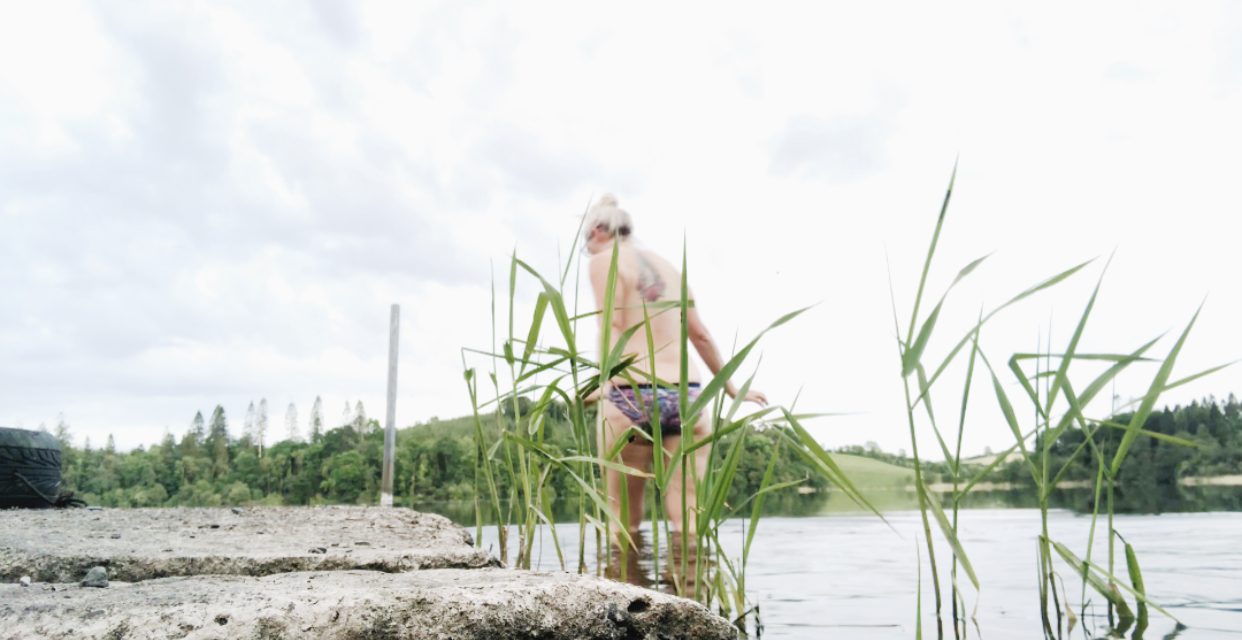
Photo: Anna Hickey-Moody
(ii)
Tarntanya/Adelaide
Christmas eve. A warm summer wind blows down Hindley Street, it’s coming up off the sea. Soothingly, it brushes the soft skin of my face, my fine blonde hairs stand on end. Hello night. Brightly coloured neon globes welcome us in. Being poor presents barriers that come up in different ways, especially at Christmas. At the insistence of our exhausted mother, Dad has taken us to look at the rides at Downtown, our small city’s answer to an amusement park. It is an indoor arcade—bumper cars, go karts, shooting ranges, ghost trains. Lights flash in multicolours, machine noises trill and bing. Kids with money roam around, laugh, and pose. The warm breeze, coloured lights and machine noises are cut through with screams of excitement, music and the ‘chi-ching’ of machines winning prizes for teenagers drinking sugar out of oversized paper cups. We can look, but not play. There is something inexpressibly sad about walking around the sideshow games with my father and brothers, watching other people having fun. The spectacle of a happy life. Free viewing for those with nothing better to do. There is something inexpressibly sad about our life. Dad is so angry all the time. Mostly, his unfettered rage and violence chase me down the very back of the garden where I play with my imaginary friends.
While we are out, watching people with money have fun, Mum is at home, whipping up our Christmas presents in her carefully kept kitchen. The kitchen is her space, not solely because the “woman’s work “ of cooking is always delegated to her, but because my father won’t eat with his children. We are too loud. He takes his meal into the lounge and enjoys it alone, in front of the television.
The early Kooka stove is a source of magic in Mum’s kitchen. After school she stokes a wood fire under the hotplates and makes pikelets, on weekends she makes pancakes, and stews on the black rangehood. The oven, protected by the enamel image of the Kookaburra, produces her delicious soda breads, casseroles, and roast chicken for a treat.
One of my favorite things is Sunday night boiled puddings. Often there is not enough food to fill us up, so Mum makes a big boiled treacle or golden syrup pudding for dessert. While we eat our meat and vegetables, the lid of the saucepan holding the pud jiggles along, saying “not long now”… soft, sweet, hot, pudding is on the way. Fluffy warm clouds of wheat with runny golden syrup rivers. Steam and sugar rise up the nostrils and the kitchen windows, now covered with condensation. Sugar droplets run down the edges of my chin.
In between feeding and clothing three children and working part time, Mum sews us all special bed linen sets to match our rooms. The pillowcases Mum makes me have pink ribbon and white lace trimmings. The starched cotton is cool and soft on my skin, the lace trimmings tickle my nose, a smooth capital A in shiny, hot pink ribbon stands proudly in the right hand corner of the case.
*
My 16 year old skin pulls tight across my stomach as I lie flat on the bottom bunk, holding the slats of the bed above me to focus my thoughts. The seemingly giant ‘piercing needle’ is supposed to seamlessly pull the stainless steel jewellery through my soft skin, though as he pulls harder and harder to get the end of metal to come out to other side, it isn’t working. It takes two attempts, and finally the fat round end of the large stud is attached to the bar stuck through the weeping wound of two experimental holes.
(iii)
Naarm / Melbourne
The air is thick with smoke all the time. As the fires to the north burn down the coast, grey smog and soot washes over our atmosphere as the horizon blurs into a misty haze. My lungs wheeze. We buy an air purifier and watch the red icons representing the blaze move along the digital maps that light up our phones. My mother spends five nights on the Bega oval, along with the members of her shire who hadn’t, with their children and pets, managed to escape the region. Budgerigars, horses, dogs, cats, seas of people and smoke so thick that no one can see the sky. We come to hate the smell of smoke and the ever increasing kinds of loss it brings with it.
As a child, I loved the fact that my job was to light the fire. The sulfuric smell of the matches striking on the side of the box. Sharp and itchy in the nostril. The blue flames as the edge of the paper take off, the advertising pages going up in color before the feature articles burn orange and yellow. The smoky little twigs crackling under the briquettes, each different kind of flammable matter generating a new color in the flame: green-blue, light yellow, orange. Snap, crackle, smoke, the scene draws me in through smell, sound, color, and I blow under the little sparky flames with the biggest breaths I can hold in my lungs, blowing until I have run out of air, and watching the little flames grow, as if to say ‘thank you’ for giving them life.
No one ever found out how the Black Summer megablaze began. Between 2019–2020, the fires burned about 5.5 million hectares of land, destroyed 2,476 homes, and resulted in the loss of 26 lives. Over 800 million animals died, with some species pushed to the brink of extinction. The fires destroyed critical habitats, leading to long-term ecological consequences. These fires smell completely different from the loungeroom fires I was tasked to light as a child.
*
I can feel some movement in my stomach. I can’t feel its shape as it grows, but the skin is pulled tight across my abdomen which is slightly popped out. My breasts are so sore I can’t bear to touch them. That was how I realised I am pregnant. “I will kill myself if you have that baby.” What a cruel thing for someone to say. I still wish I had been brave enough to test out his resolve. He paid for the abortion out of guilt. I adopted a kitten from the animal hospital.
*
The end of my cigarette crackles momentarily as the butane flame and white paper light a thin trail of smoke. My lungs choke, thick with the smoke sticking to the pink capillaries and turning them black with stinky tar. The white thread rising from the little cigarette connects me to my English grandmother who, before she became unwell, lived on a diet of Kent cigarettes and tea, cooking three course meals and preparing constant snacks for her husband and family, and watching us consume the food she worked so hard to bring into the world. It was only once Nan was really quite unwell, and clearly not going to recover, that she finally came to embody her appetite. Her little bird-like form loved desserts. At her last Christmas celebration she enjoyed trifle, pudding, and cake: why choose one when you can have all three? I wished my Nanna had eaten more fluffy sweet sugary things and lived less on grey Smokey tendrils and English tea.
*
I can hardly walk. I can’t find a way to explain the pain that makes sense. It is in my lower right side, in my womb, but it is hard to press it and catch exactly the sore spot. It moves around. That sounds mad. How can pain move around your abdomen? The nurse at the hospital check in counter hands me two Panadol and a small cup of Gaviscon. “Try this” she says. I don’t say “it’s not indigestion.” But I know it’s not. (What if it is? What if I am actually hysterical?). The doctor at the hospital injects me with something that makes my body hot and tingly and they run me through a CT scan. I am in perfect health. There are no problems with my stomach. The pain isn’t really in my stomach, I try to explain. It is in my womb. I google ‘expert gynaecologists’ in Melbourne and book in to see the man with the most stars in his reviews. In a disparaging tone, his secretary informs me he only sees private patients and I have to pay upfront. I don’t care if they need me to pledge my organs, I just need help.
The expensive gynaecologist has his son’s artwork framed on the walls and a view of the city that you can only afford if you are earning a six figure salary. I explain the pain in my right side. It’s not my gallbladder, appendix, or kidney. It’s down lower. Sometimes it moves around, and I can’t seem to touch it. It gets so bad that I go grey, can’t stand up. I lie in bed and cry. These are not feeling like very clear symptoms. It is extremely bad pain, I explain. He books me in for surgery.
The surgery is three and a half hours long. The expensive gynaecologist removes stage four endometriosis from my womb and my right ovary, which had been strangled to death by a ‘chocolate cyst’ which is the proper noun given to dark brown cysts that grow with endometriosis. The cyst was wrapped around the right ovary ‘flapping back and forth’, the doctor explains, which is why the pain became extreme with no apparent cause. The Flapping. The cyst was flapping, he says. It is not a word I use very often. There are answers. There are even photographs like science fiction landscapes that the gynaecologist has taken to prove his diagnosis. I don’t want to see them. I am not supposed to be like that inside.
(iv)
Cill Dara/Kildare
Living amongst the bog that traps cars and invites all surfaces to be covered in protective concrete, I am a bog woman. Be careful, I might pull you down with me into the black sticky soil from which there is no escape. Bog bodies in Ireland are famous, preserved by the oxygen-poor conditions of peat.
Dating to the Iron Age (500 BCE to 500 CE), bog bodies keep skin, hair, and clothing intact for thousands of years. Some show evidence of violent deaths. Broken bones, stab wounds, signs of strangulation suggest these bodies have been deliberately placed in bogs as offerings to gods, as a part of societal rituals, or as a way of hiding a terrible wrongdoing.
The Ballynahatty Woman is the name given to the famous archaeological find of a bog woman, a prehistoric female whose remains were discovered in 1855. She is estimated to have lived 5,200 years ago. Geneticists from Trinity and archaeologists from Queen's sequenced her genome, marking the first time ancient Irish human DNA had been analyzed. This revealed that the famous bog woman had black hair and brown eyes, traits typical of southern European populations. Her genetic makeup indicated ancestry originating from the Middle East. Like her, I am of here, but I am read as not belonging here. I bring this fact up repeatedly in public when faced with arguments about immigration in Ireland and even more consistently in my own mind, when a particular strain of self-righteous Irish woman implicitly questions my right to exist on the island. If I sounded Irish would they be different? I wonder. They are all ‘weapons’. I tell myself. I make lists of safe people to talk to. I am up to 10.
The fog that rises off the canal is thick, like bushfire smoke. Inside the grey white cloud I can’t see what’s in front of me, bodies appear and fall behind me like ghosts. Unlike the fires, the fog brings no smell. It is just as thick and disorientating, but no odor. It sticks to the body and my glasses in a wet film. Like the smoke, this grey white mist chokes me. I can’t breathe in and out. My lungs are not working. I am trapped.
Alone in the mists that cover the bog, I am relatively safe from the women who are like weapons. Not entirely, but fairly removed. Barren woman in mist. Is this it? My hip hurts as I cycle through the grey cloud. I ache to be in the ground, but also to be lifted out of this life, into the worlds I make with words—like the worlds I made at the bottom of the garden. My barren belly presses against the clasp of suit pants, without pain inside it, or reason to fear it, other than its gentle expansion. I ride on, through the mist.
References
- Australian Bureau of Statistics (2023). “Partner violence,” Australian Institute of Health and Welfare. Available at: https://www.aihw.gov.au/family-domestic-and-sexual-violence/resources/fdsv-summary [Accessed 23rd September, 2024].
- AIDR Knowledge Hub (2024). “News,” AIDR Knowledge Hub. Available at: https://knowledge.aidr.org.au/news/ [Accessed 23rd September, 2024].
- von Radowitz, J. (2015). “She Lived in South Belfast 5,200 Years Ago,” Belfast Telegraph, 29th December. Available at: https://www.belfasttelegraph.co.uk/news/northern-ireland/she-lived-in-south-belfast-5200-years-ago-now-this-neolithic-woman-is-providing-new-clues-about-the-origins-of-human-settlement-in-ireland/34319447.html [Accessed 12th May, 2024].
Anna Hickey‑Moody is Director of the Arts & Humanities Institute and inaugural SALI Professor of Intersectional Humanities at Maynooth University; formerly Professor of Media & Communication at RMIT (Australia). She has over 269 publications, including peer-reviewed papers and edited volumes. Her authored books include Faith Stories (MUP, 2023); Childhood, Citizenship & the Anthropocene (R&L, 2022); Deleuze and Masculinity (Palgrave 2019); Youth, Arts and Education (Routledge 2013); Unimaginable Bodies (Brill 2009); Masculinity Beyond the Metropolis (Palgrave 2006); among others. In 2015 Hickey‑Moody initiated research in what she calls 'carbon cultures', focusing on how communities relate to carbon in cultural and material terms and laying the groundwork for her current work on carbon capture/peat studies. This trajectory lead her to engage with peat and bogland —a major carbon store in Ireland—and assess its roles in environmental stewardship and within Irish gendered cultural identities. Her autofiction explores how Irish peatlands figure in heritage-making, climate literacy, and collective imaginaries of belonging alongside investigating the key themes of Irish culture and society of diasporic identities and the woman as outsider.